
Drive Patina Reference
Porsche 912 Year Identification14 parts that reveal the model year — no chassis number required
A Porsche 912 changed in dozens of small ways nearly every year between 1965 and 1969 — from the dashboard to the windshield wipers to the shift knob. These features aren’t a substitute for the chassis number, but they’re an excellent cross-check: does the equipment actually match the claimed model year, or have parts been swapped over the decades?
The 14 parts below are ordered by reliability and visibility — each with a direct answer and the exact years behind it.
The chassis number remains the most reliable source. Part-level features help with cross-checking, but don’t replace a VIN check — precisely because parts get swapped or retrofitted over 60 years.
| Part | Key turning point |
|---|---|
| Dashboard | By paint, gauges and trim: early 1965 cars have a body-colour painted dash with three gauges, then matte black with an aluminium strip, five gauges from 1967, white lettering from 1968, and a basket-weave strip instead of aluminium in 1969. |
| Wheelbase & bodywork | By the round torsion-bar cap ahead of the rear wheel: right next to the wheel arch = short wheelbase (through 1968), a few centimetres away = long wheelbase (1969). Porsche and Karmann built bodies in parallel. |
| Steering wheel | By diameter and horn control: 42 cm with a horn button through 1968; from 1969 smaller (40 cm) with a padded horn bar. |
| Wipers | By park position and finish: through 1967 they park on the right and are painted silver; from 1968 they park on the left and are black. |
| Badging & bumpers | By the script on the engine lid: through 1966 the “912” is italic and slanted on the right, above a tightly spaced “PORSCHE”; from 1967 it sits upright and centred, with “PORSCHE” in spaced individual letters. |
| Shift knob | From March 21, 1967, per an original Porsche factory service bulletin — before that, the knob was plain. |
| Wheels & rim width | By rim width: 4.5-inch steel wheels through 1967, 5.5-inch from 1968. Fuchs wheels optional from 1967, initially also 4.5 inches. |
| Engine bay | By engine mount, crossmember and decals: revised mounting with a reinforced crossmember from 1967, a stronger generator and three factory decals from 1968, a six-bolt crossmember in 1969. |
| Door handles & windows | By door-handle shape (round through 1967, with a recessed, protected lock from 1968), the matte-black door frame through 1967 and the front quarter window (fixed on the coupé from 1969). |
| Gearbox shift pattern | 1966 – before that it cost DM 340 extra over the standard 4-speed, which remained available on request afterwards. |
| Interior mirror | By material and mounting: chromed and screwed to the roof through 1967, plastic with a break-away clip mount in 1968, black and glued to the windshield from 1969. |
| Engine & horn grilles | By the rear engine grille: with a centre bar until the end of 1967, a continuous grille without centre bar from January 1968. At the front: horn grilles held by four screws until about mid-1966, then two, and usually narrower in 1969. |
| Seats & headrests | By the adjuster lever and headrests: lever on the door side through 1968, on the tunnel side from 1969. Optional chrome-bar “slumber rolls” through 1967, slot-in headrests from January 1968. |
| Sun visors, headliner & floor | By colour and mechanism: white on both sides in 1965/66, two-tone from 1967 (Targa all black), swivelling sideways from 1969. The headliner was light grey, beige from 1969 – never black. |
01How can I tell my 912’s model year from the dashboard?
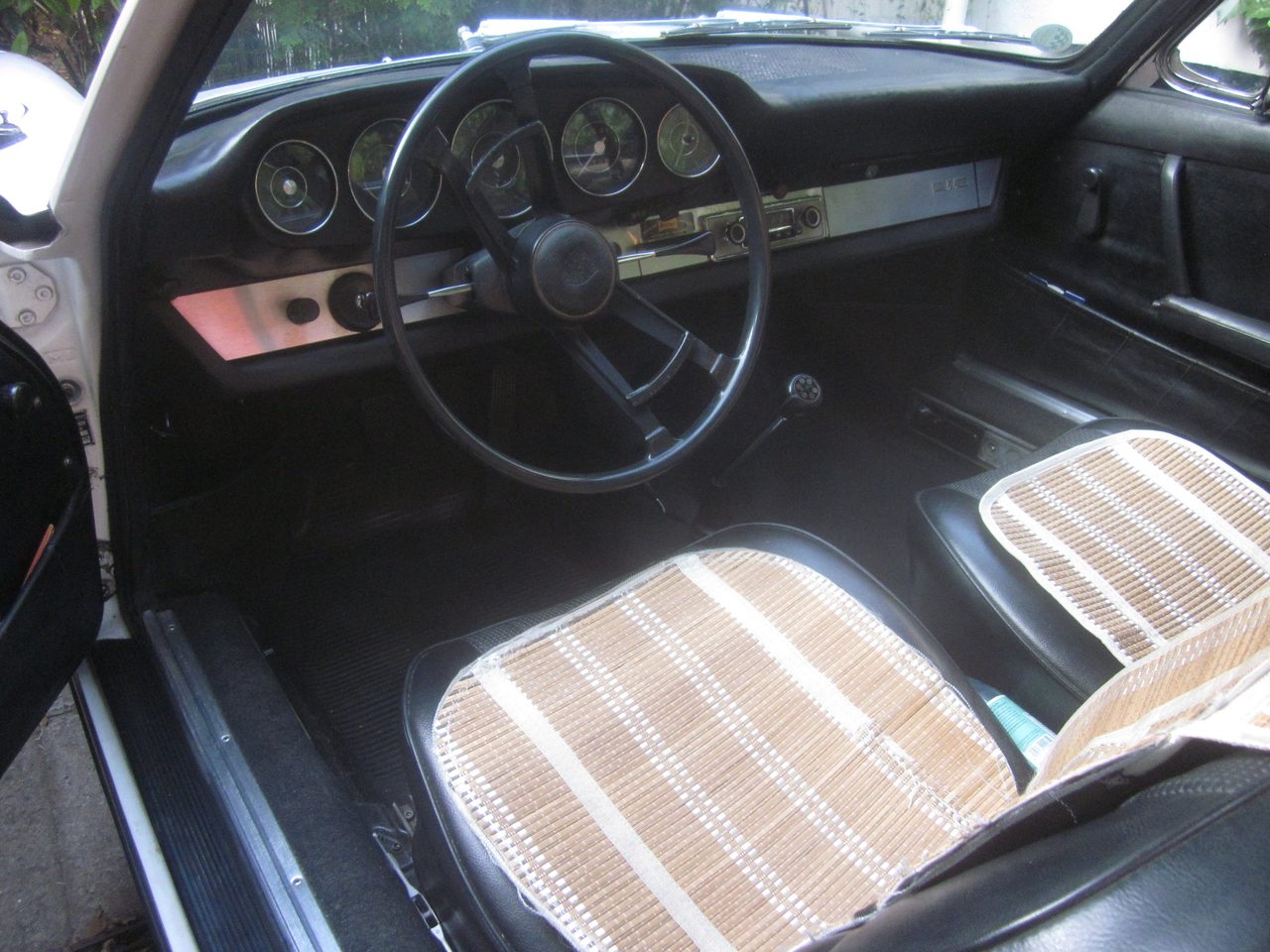
By paint, gauges and trim: early 1965 cars have a body-colour painted dash with three gauges, then matte black with an aluminium strip, five gauges from 1967, white lettering from 1968, and a basket-weave strip instead of aluminium in 1969.
Few parts tell the 912 timeline as clearly as the dashboard. Early 1965 cars have it painted in body colour – only the padded top stays black – with three round gauges: tachometer in the centre, the combination gauge for temperature and fuel on the left, the speedometer on the right. The often-quoted figure of only 150 “painted dashboards” has been disproved; there are many more. Probably from the second half of 1965 the face turns matte black with an aluminium trim strip, still with three gauges. Five gauges become standard in 1967. 1968 brings more modern instruments: white lettering on black, red needles, no chrome bezels. In 1969 a basket-weave strip replaces the aluminium trim, joined by a fan-assisted ventilation system, a lit glovebox and an ashtray in the knee bolster. The glovebox dates a car too: through 1966 the lock and handle sit in the centre and the “912” on the lid is italic; from 1967 the lock moves to the left, a full-width grab rail appears and the model name stands upright. Buyer tip: the hard-foam 1969 dash typically cracks just right of the gauges.
02How can I tell short from long wheelbase – and who built the body?
By the round torsion-bar cap ahead of the rear wheel: right next to the wheel arch = short wheelbase (through 1968), a few centimetres away = long wheelbase (1969). Porsche and Karmann built bodies in parallel.
Porsche specialists distinguish the 0-series (short wheelbase through model year 1967), the A-series (model year 1968, also short) and the B-series (1969, long). For the B-series the rear wheels moved back 57 mm, shifting weight distribution from 41.5/58.5 to 43/57 per cent front/rear. The quickest way to spot it from outside is the round torsion-bar cap ahead of the rear wheel: on short-wheelbase cars it sits almost at the wheel-arch opening, on long-wheelbase cars clearly further forward. 1969 cars also have slightly flared wheel arches, revised light housings and narrower horn grilles. From day one two plants built bodies in parallel – Porsche in Zuffenhausen and Karmann in Osnabrück – purely a question of capacity. Which plant built a particular car is revealed by the chassis number. The shape is the work of Ferdinand Alexander “Butzi” Porsche together with Erwin Komenda, who had already shaped the 356.
03How can I tell the model year from the steering wheel?
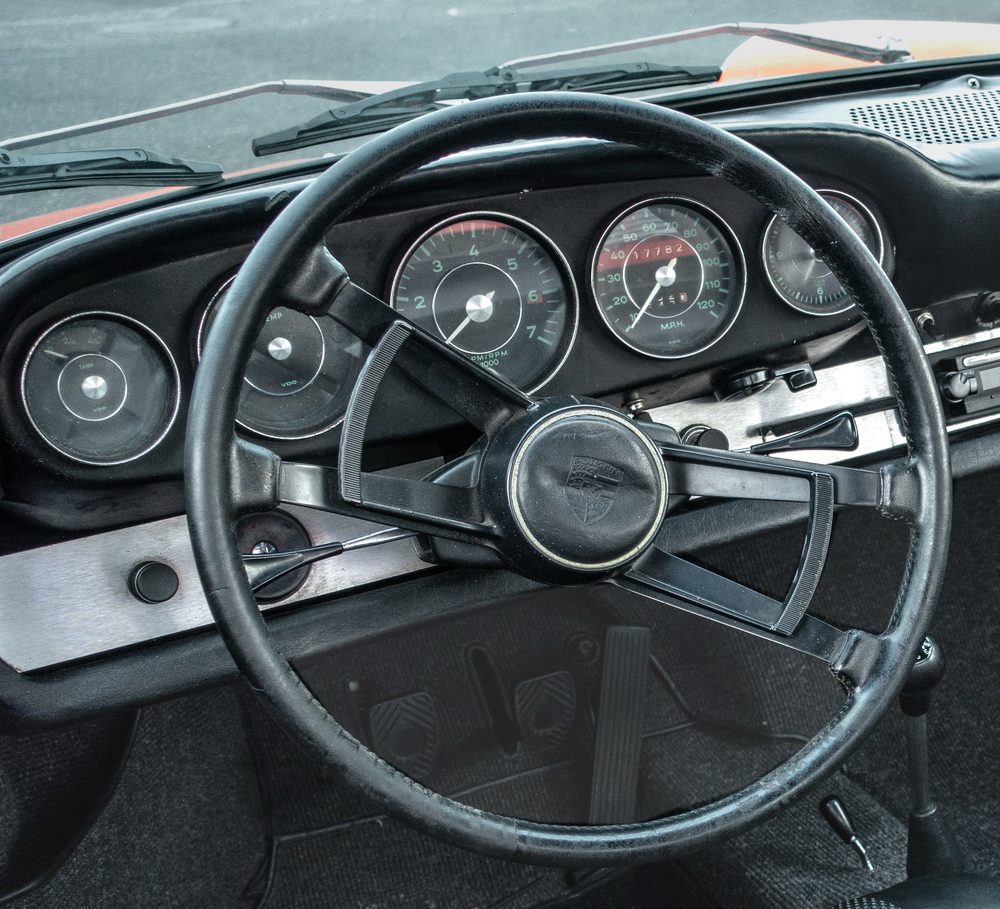
Photo: Marty B, CC BY-SA 2.0, via Wikimedia Commons
By diameter and horn control: 42 cm with a horn button through 1968; from 1969 smaller (40 cm) with a padded horn bar.
The 912’s standard wheel was a plain 42 cm Bakelite plastic wheel with a simple horn button – one of the savings compared with the 911. From model year 1966 a leather cover was available. Options included a wooden wheel, also 42 cm, and a butterfly-shaped horn bar. In 1969 the wheel shrank to 40 cm, got a more modern design and a padded horn bar as standard, still butterfly-shaped. Be careful with wooden wheels: many come from the aftermarket; originals can be recognised by black rivets and stamped markings, among other things. From 1965 a hub spacer raising the wheel by 30.5 mm could also be ordered.
04How can I tell the model year from the windshield wipers?
By park position and finish: through 1967 they park on the right and are painted silver; from 1968 they park on the left and are black.
A detail even experienced buyers miss: through model year 1967 the 912’s wipers park on the passenger side. The arms are painted silver, not chromed – chrome arms are a later swap for looks. From 1968 the wipers park on the driver’s side, and arms, blades and cap nuts turn black. The system then stayed unchanged until 1973, which is why many non-original combinations are around today. The aluminium washer jets were carried over unchanged from the 356C. A rear wiper was only a rare accessory for the coupé and for Targas with a glass rear window – listed in the catalogue from September 1965, but probably not actually delivered before 1967.
05How can I tell the model year from the badging and bumpers?
By the script on the engine lid: through 1966 the “912” is italic and slanted on the right, above a tightly spaced “PORSCHE”; from 1967 it sits upright and centred, with “PORSCHE” in spaced individual letters.
The script on the engine lid dates a car reliably. In 1965 and 1966 the “912” model name sits italic and slanted at the upper right, with “PORSCHE” tightly spaced and centred along the bottom edge. From model year 1967 the “912” stands upright and centred at the top edge, and “PORSCHE” is made of individual, spaced letters. The 912’s rear scripts were always silver, never gold – only the Targa script on the roll bar is gold. On the bumpers: the overriders were chromed as standard; rubber inserts were available from October 1965 at DM 14.25 each, and from 1967 all overriders get a black plastic guard on top. The three-piece rear bumper gains extra reflectors in 1969 and is revised for the longer wheelbase. Factory bumper guards existed only for the rear, bolted to special overriders on the outside; the common AMCO guards, mounted between the overriders, are aftermarket.
06When did the 912 get a shift knob with the gear pattern printed on it?
From March 21, 1967, per an original Porsche factory service bulletin — before that, the knob was plain.
This detail even has a date from Porsche’s own workshop bulletin: from 21 March 1967 all 911, 911 S and 912 cars receive a shift knob with the 4- or 5-speed pattern printed on top – before that the knob was plain. At the same time the thread on the gear lever was dropped: the new knob is pressed on with a tolerance ring so it cannot twist. If you want to narrow down when an early 1967 car was built, you will rarely find a more precise cut-off date.
07How can I tell the model year from the wheels?
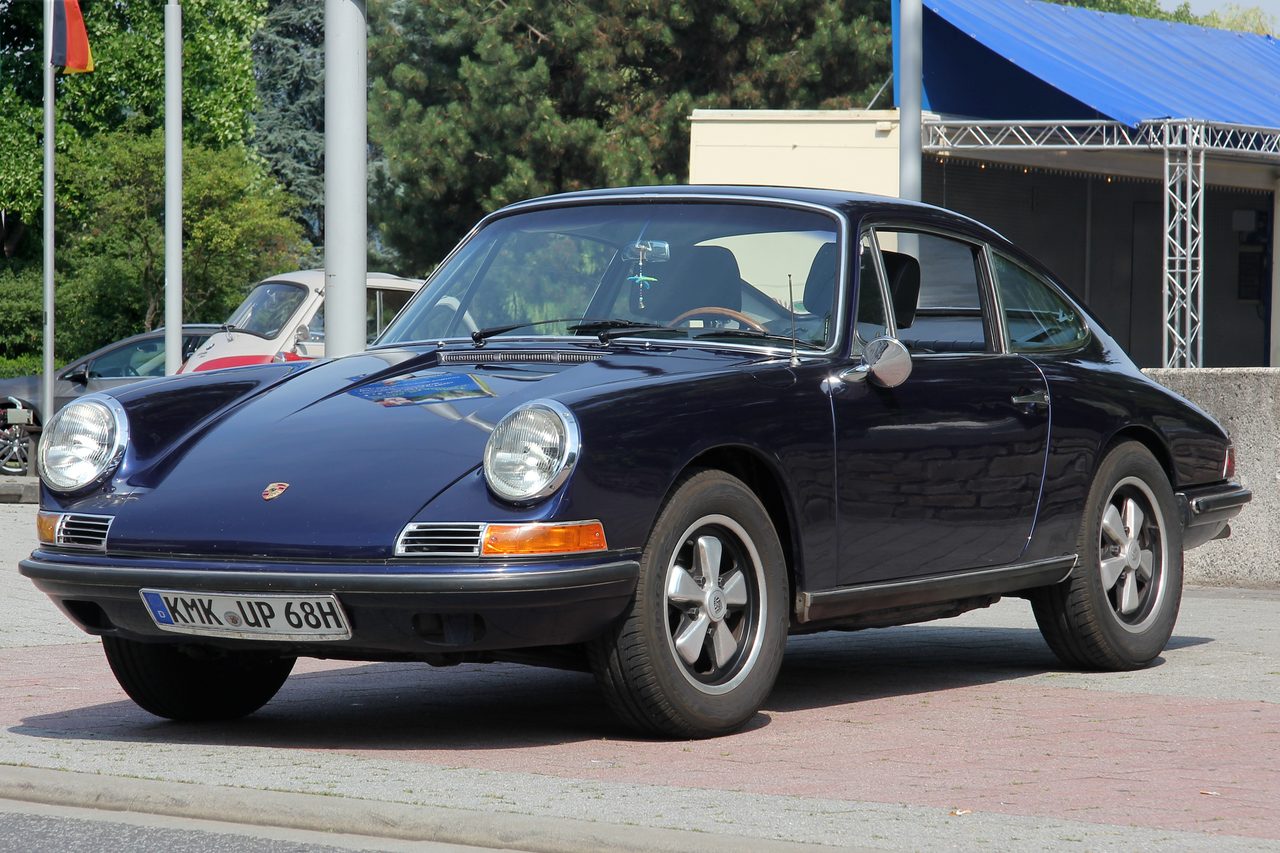
Photo: Lothar Spurzem, CC BY-SA 2.0 DE, via Wikimedia Commons
By rim width: 4.5-inch steel wheels through 1967, 5.5-inch from 1968. Fuchs wheels optional from 1967, initially also 4.5 inches.
Rim width dates a car almost as reliably as the dashboard. Standard were 4½×15 steel wheels – carried over from the 356C in 1965 – painted silver or chromed at extra cost, supplied by Kronprinz or Lemmerz. From model year 1968, 5½×15 becomes standard. The forged Fuchs wheels, shown at the 1965 IAA and introduced on the 911 S in 1967, were available on the 912 at a hefty premium: first as 4½×15, as 5½×15 in 1968/69 and also as 6×15 in 1969. From 1969, 5½×14 could be ordered too. Original Fuchs wheels are matte anodised, the early ones with hardly any black accents. Mirror-polished Fuchs wheels never left the factory – in Germany they tend to lower a car’s value. Alloy wheels were never standard on the 912 and rare at the time.
08How can I tell the model year from the engine bay?
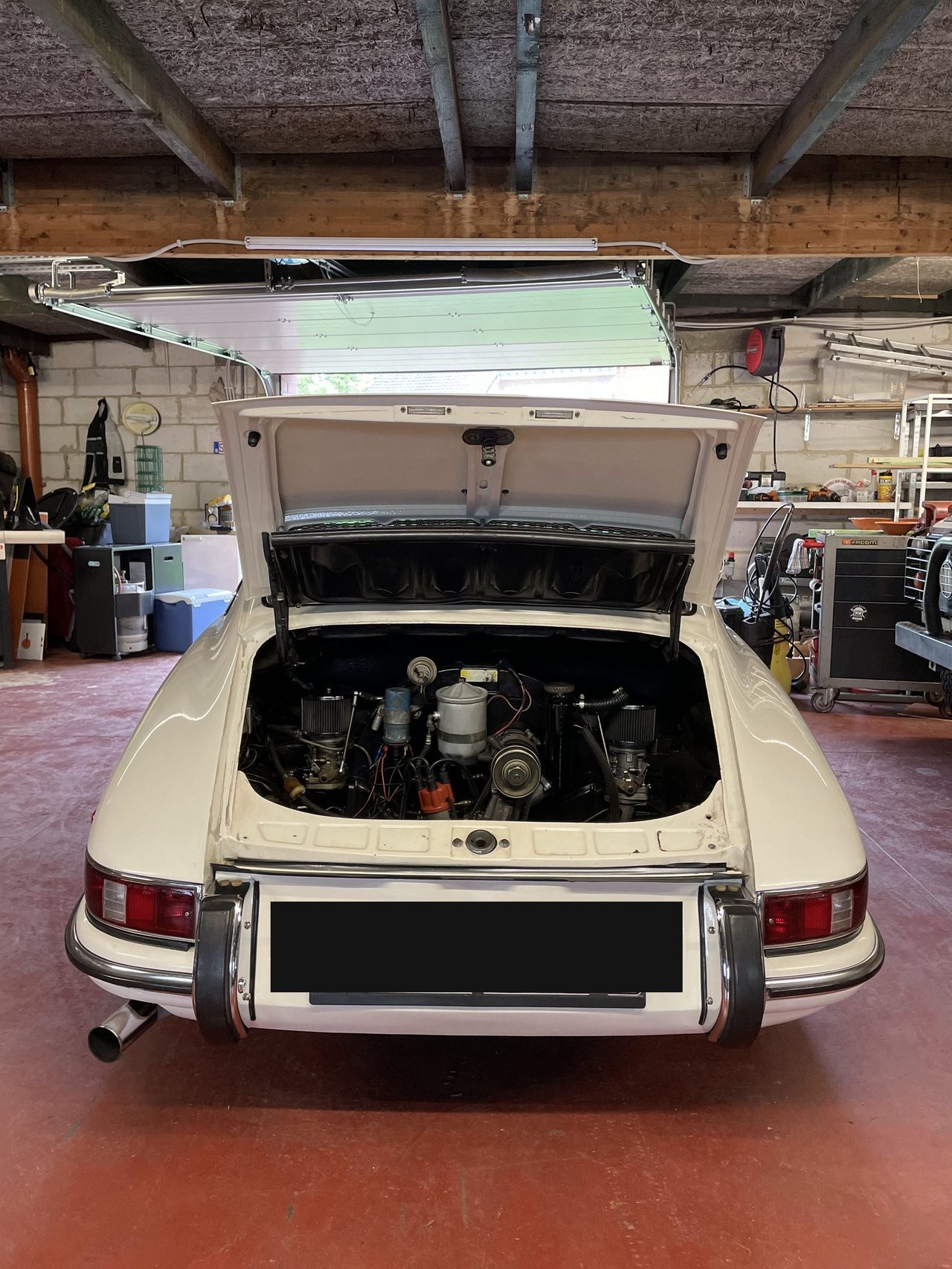
By engine mount, crossmember and decals: revised mounting with a reinforced crossmember from 1967, a stronger generator and three factory decals from 1968, a six-bolt crossmember in 1969.
The engine bay shows the 912 maturing most clearly. The very first 1965 cars have strikingly large air cleaners, replaced by slimmer ones within the same year, and a thin “sword” engine mount that let the engine run noticeably rough. For model year 1967 Porsche revised the engine mounting and reinforced the crossmember – the engine runs much more smoothly afterwards. From 1968 come a stronger generator and three factory decals: valve clearance on the fan housing, an upside-down BOSCH decal and the H-filter note on the oil tank. In 1969 the crossmember is fixed with six bolts, and a rain tray under the engine grille is standard. The engine bay was always painted black at the factory – a body-colour engine bay points to a restoration.
09How can I tell the model year from door handles and windows?
By door-handle shape (round through 1967, with a recessed, protected lock from 1968), the matte-black door frame through 1967 and the front quarter window (fixed on the coupé from 1969).
The door handles, made of chromed zinc die-cast, are round through 1967. In 1968 the US Department of Transportation demanded a safer design: the lock cylinder now sits protected in a recess and the handle looks more angular. Often overlooked: through 1967 the inner door frame is finished in matte black rather than body colour. Door panels are smooth through 1967, basket-weave from 1968, and get new pulls and map pockets in 1969. The window cranks stay the same until early 1968, then become stronger and fully padded. On the coupé the front quarter windows are fixed from 1969 – the new fan-assisted ventilation made them unnecessary – while the Targa keeps them opening. The coupé’s rear pop-out windows have chromed brass frames through 1967 and bright anodised aluminium from 1968. On the Targa the folding plastic rear window (“soft window”) gives way to fixed glass in 1968, and tinted glass becomes standard in 1969.
10When did the 5-speed gearbox become standard on the 912?
1966 – before that it cost DM 340 extra over the standard 4-speed, which remained available on request afterwards.
In its first year the 912 came standard with a 4-speed gearbox that proved poorly spaced: the engine had to be revved very high to pull the next gear. The 5-speed cost DM 340 extra, was ordered accordingly often and became standard in 1966, with the 4-speed still available on request. Takes some getting used to: on the 5-speed, first gear sits to the left and back, outside the H-pattern. The owner’s manual gave specific rpm limits for downshifts – 4,500, 3,900 and 3,200 rpm on the 4-speed, 4,800 down to 3,500 rpm on the 5-speed.
11How can I tell the model year from the interior mirror?
By material and mounting: chromed and screwed to the roof through 1967, plastic with a break-away clip mount in 1968, black and glued to the windshield from 1969.
Through 1967 the interior mirror and its arm are chromed and fixed to the roof above the windshield frame with three screws, the same on coupé and Targa. In 1968 it becomes two-piece: the plastic mirror clips into a fixed base and breaks away in an impact – the same mirror was also used in the Mercedes W114/W115. In 1969 it moves, all in black, directly onto the windshield, held by an adhesive pad that often comes loose over the years. The vanity mirror in the passenger sun visor was standard from the start; only US cars initially went without.
12How can I tell the model year from the engine and horn grilles?
By the rear engine grille: with a centre bar until the end of 1967, a continuous grille without centre bar from January 1968. At the front: horn grilles held by four screws until about mid-1966, then two, and usually narrower in 1969.
The vent grille on the engine lid has a centre bar until the end of 1967 and is split in two underneath. From January 1968 – here, unusually, the build date counts rather than the model year – a continuous grille without a centre bar and with three vertical struts takes over, so early 1968 cars may still carry the old lid. At the front sit the chromed horn grilles: until about mid-1966 they are held by four screws, then by two. With the long wheelbase they become narrower in 1969, although some 1969 cars still have the wide grilles. The fresh-air grille ahead of the windshield is matte anodised on early 1965 cars and later painted or anodised black.
13How can I tell the model year from the seats?
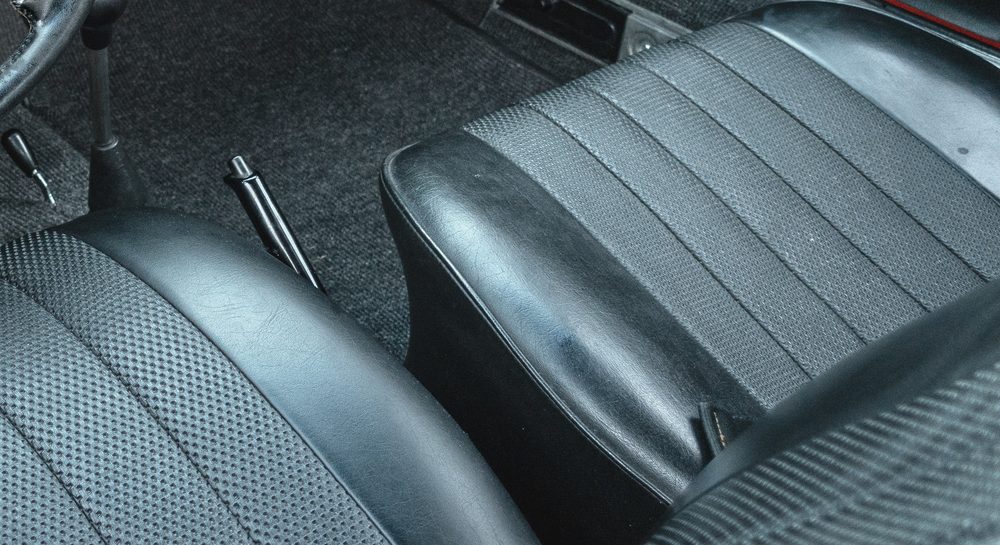
Photo: Marty B, CC BY-SA 2.0, via Wikimedia Commons
By the adjuster lever and headrests: lever on the door side through 1968, on the tunnel side from 1969. Optional chrome-bar “slumber rolls” through 1967, slot-in headrests from January 1968.
The quickest check is the fore-aft adjuster lever: on short-wheelbase cars through 1968 it sits at the front on the door side, from 1969 on the tunnel side. Headrests were always an extra: through 1967 there were “slumber rolls” on a curved chrome bar, as on the 356; from January 1968 headrests slot into the backrest from above. From January 1969 they were mandatory on new US cars. Only the very first 1965 seats have six upholstery pleats; after that there are five. Options included leather (with a smooth centre section through 1967, basket-weave from 1968), a Pepita houndstooth centre panel from a 912-only colour chart, and a seat raised by 20 mm. The rear jump-seat backs were always smooth, never basket-weave.
14How can I tell the model year from the sun visors?
By colour and mechanism: white on both sides in 1965/66, two-tone from 1967 (Targa all black), swivelling sideways from 1969. The headliner was light grey, beige from 1969 – never black.
The sun visors in 1965 and 1966 coupés are white on both sides and only flip up and down. From model year 1967 they are white towards the windshield and black towards the cabin, with ivory mounts; the Targa has all-black visors. 1969 brings visors with black mounts that also swing sideways (not on the Targa). The coupé headliner is light grey, almost white perforated vinyl, beige from 1969 – a black headliner never came from the factory on a 912. Rubber mats covered the floor through 1968, with dark grey bouclé on the sides; material and shade changed from 1967, and from 1969 every 912 had carpet instead of rubber mats.
Get updates
Get notified about corrections to the year-identification features
No newsletter — just an email if we find new sources or correct a number.
Sources
This page summarises documented equipment changes and presents them in our own words. For registry, parts and factory detail, the public “912 im Detail” wiki on 912-group-urzwölfer.de served as the main source, supplemented by an original Porsche factory service bulletin on the shift-knob change.